
Your Pocono Summer Wellness Guide: Hemp, Hiking & Finding Your Balance
Reading Time: ~7 minutes | Category: Wellness Lifestyle / Local Pocono
If you've ever walked into a hemp store and wondered, "Wait — is this actually legal?" — you're not alone. Hemp has had a complicated legal history in the United States, and there's still a lot of confusion out there.
The short answer? Yes, hemp is federally legal. But there's more to the story — and as a consumer, you deserve to understand it.
What Is the 2018 Farm Bill?
The Agriculture Improvement Act of 2018 — commonly called the 2018 Farm Bill — was a landmark piece of federal legislation signed into law on December 20, 2018. While the bill covered a wide range of agricultural policy, one section changed everything for the hemp industry.
For the first time in decades, the 2018 Farm Bill removed hemp from the federal Controlled Substances Act. That means hemp is no longer classified as a Schedule I drug alongside marijuana. It became a legal agricultural commodity — like corn, soybeans, or cotton — that can be grown, processed, and sold across the United States.
Hemp vs. Marijuana: The Legal Distinction That Changes Everything
The 2018 Farm Bill doesn't legalize all cannabis. It specifically legalizes hemp — and the distinction comes down to one number.
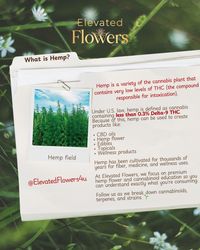
Under federal law, hemp is defined as Cannabis sativa L. containing no more than 0.3% Delta-9 THC by dry weight. Any cannabis plant that exceeds that threshold is legally classified as marijuana.
Same plant family. Very different chemistry. And a very different legal status.
This is why every product at Elevated Flowers is compliant with federal law. All of our products are sourced from hemp plants that test at or below the 0.3% Delta-9 THC threshold — confirmed by independent, third-party laboratory testing on every batch.
What the Farm Bill Actually Changed
Before 2018, hemp was illegal at the federal level — full stop. Farmers couldn't grow it commercially. Retailers couldn't sell it. Consumers had almost no access to legal hemp products.
The 2018 Farm Bill changed that in several meaningful ways:
Hemp can now be legally grown. Licensed farmers across the U.S. can cultivate hemp as a regulated agricultural crop under USDA oversight and state department of agriculture programs.
Hemp products can be legally transported and sold across state lines. Products derived from compliant hemp — including tinctures, topicals, edibles, capsules, and hemp flower — can move interstate legally, opening the door to a national market.
Hemp research is now permitted. Scientists and institutions can study hemp and its compounds without the legal barriers that previously blocked research for decades.
What the Farm Bill Did NOT Do
It's equally important to be clear about the limits of this law.
The FDA still regulates CBD in food and supplements. The agency has not approved CBD as a food additive or dietary supplement ingredient at the federal level — which is why you'll see specific disclaimers on hemp products.
States retain the right to set their own rules. Individual states can regulate hemp within their borders more strictly than federal law. Pennsylvania operates under the PA Industrial Hemp Act, which includes its own oversight for hemp cultivation, processing, and retail.
Medical claims remain prohibited. No hemp retailer — regardless of product type — can legally claim that products diagnose, treat, cure, or prevent any disease. If you see a hemp brand making those claims, that's a compliance red flag.
What This Means for Pennsylvania Hemp Shoppers in 2026
Pennsylvania's hemp program aligns with federal law but adds state-level requirements around testing, labeling, and retailer compliance.
Every product at Elevated Flowers meets both federal and Pennsylvania standards:
Hemp-derived, with ≤ 0.3% Delta-9 THC
Third-party tested by an ISO/IEC 17025 accredited laboratory
Certificate of Analysis (COA) available via QR code on every product or in-store
One important update for 2026: Pennsylvania has announced updated regulations effective November 12, 2026, that will require total THC — including THCA — to remain at or below 0.3%. We are actively monitoring these changes and will maintain full compliance as the regulatory landscape evolves.

You've probably heard us say it before: every product at Elevated Flowers has a COA available. But what does that actually mean? And more importantly — do you know how to read one?
A Certificate of Analysis can look overwhelming at first glance. Numbers, abbreviations, panels, thresholds. But once you know what each section means, it becomes one of the most powerful tools you have as a hemp consumer.
This is your complete, section-by-section guide.
New to COAs? Start with the basics: What Is a COA and Why Does It Matter?